Beyond Surface Level: Why Understanding Movement Changed How I TouchA Review of the Deep Tissue Massage Course at RSM International Academy
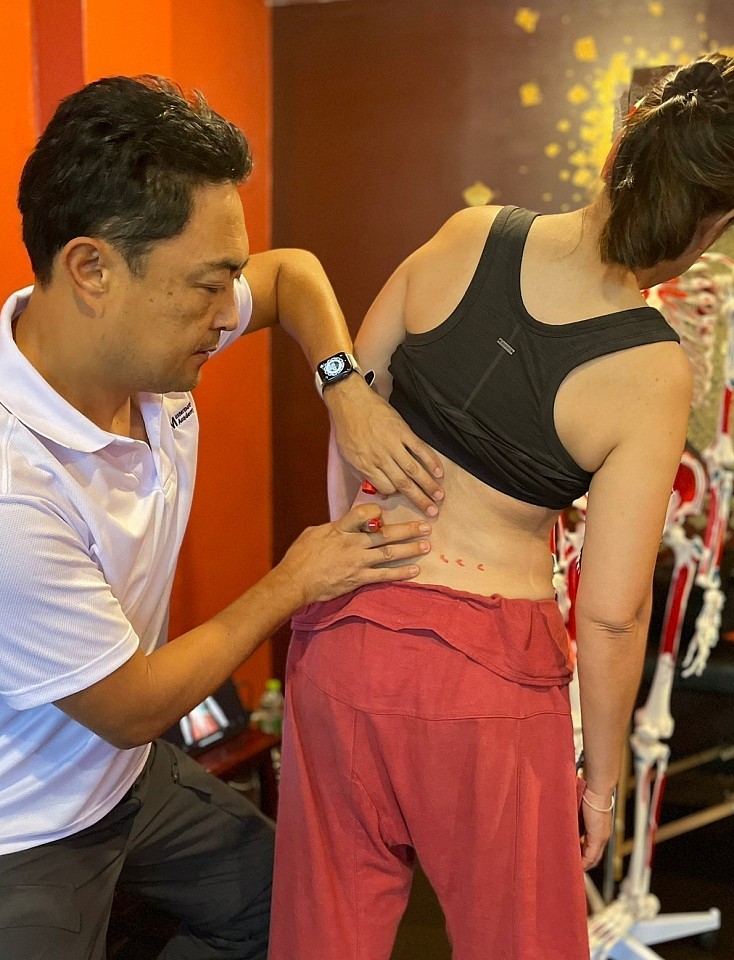
As someone who spends half my life teaching Pilates and the other half treating athletes, I look at the human body through the lens of movement. I came into the Deep Tissue Massage Course at RSM International Academy already feeling confident. I had just finished their Trigger Point Therapy module, and honestly, compared to the vague "energy work" or "intuitive touch" training I’d received at other schools in Chiang Mai, I thought I had peaked.
I was wrong. What I realized within the first hour at RSM was that my understanding of structural mechanics was still surprisingly shallow.
Visualizing the Kinetic Chain
What separates a technician from a clinician is the ability to see what isn't obvious. This course didn’t just teach me a sequence; it forced me to look at the body as an architectural structure. We analyzed over 500 detailed anatomical photos and posture reference images. For a movement professional, this was gold. We weren't just memorizing names; we were connecting kyphotic posture and pelvic tilts to chronic pain patterns.
This visual overload served as one of the essential tools for massage therapists who want to move beyond relaxation. It turned concepts like "upper-crossed syndrome" from textbook vocabulary into a practical science I could see in every student who walked into my studio.
Precision Over Power
There is a massive misconception in our industry that "Deep Tissue" equals "Pain." Before this course, I admit I sometimes relied on brute strength to get results. RSM completely dismantled that approach.
We spent days refining and developing effective pressure techniques. The focus shifted from pushing through the muscle to sinking with it. I learned to use my body weight and alignment rather than forearm strength, allowing the tissue to accept the pressure. This distinction is crucial. When you stop fighting the client’s nervous system, you stop causing unnecessary inflammation. For my athletes, this means faster recovery without the "post-massage soreness" that ruins their training schedule.
Clinical Application and Injury Management
The curriculum was incredibly relevant to the issues I see daily. We dove deep into common injuries treated by deep tissue massage, covering everything from gluteal entrapment and IT band friction to cervical tightness caused by rounded shoulders.
The training highlighted the importance of addressing specific muscle groups not in isolation, but as part of a kinetic chain. For example, realizing that an athlete’s knee pain might be stemming from fascial tension along the lateral line or a pelvic rotation changed how I assess. We learned to differentiate whether a restriction was a protective muscle guarding or a structural adhesion. This level of detail goes far beyond the standard anatomy basics for massage students taught elsewhere; it is advanced biomechanics.
Professionalism and Context
Another lightbulb moment was understanding the differences between massage modalities. Instead of just "collecting techniques," I learned when to apply deep tissue work versus trigger point or myofascial release based on the tissue's actual state.
This clarity directly improved how I communicate. Establishing rapport with clients at RSM isn't about making small talk; it’s about professional transparency. When I can explain to a client exactly why their thoracic stiffness is loading their cervical spine, and show them the logic behind the treatment sequence, the trust level skyrockets.
The Verdict
The instruction under Hironori Ikeda (MSc Sports Medicine) is unmatched. When you have a room full of physiotherapists, medical practitioners, and Olympic-level coaches all taking furious notes, you know you are in the right place.
This training bridged the gap between my movement coaching and my manual therapy. It transformed me from someone who chases pain into someone who corrects patterns. If you are serious about comprehensive clinical massage education and want to understand the "why" behind every touch, RSM is in a league of its own. It didn't just teach me massage; it reorganized my entire professional identity.